

In an era where information is commoditized and readily available via AI and search engines, the value of what we know is depreciating, while the value of who we are is appreciating.
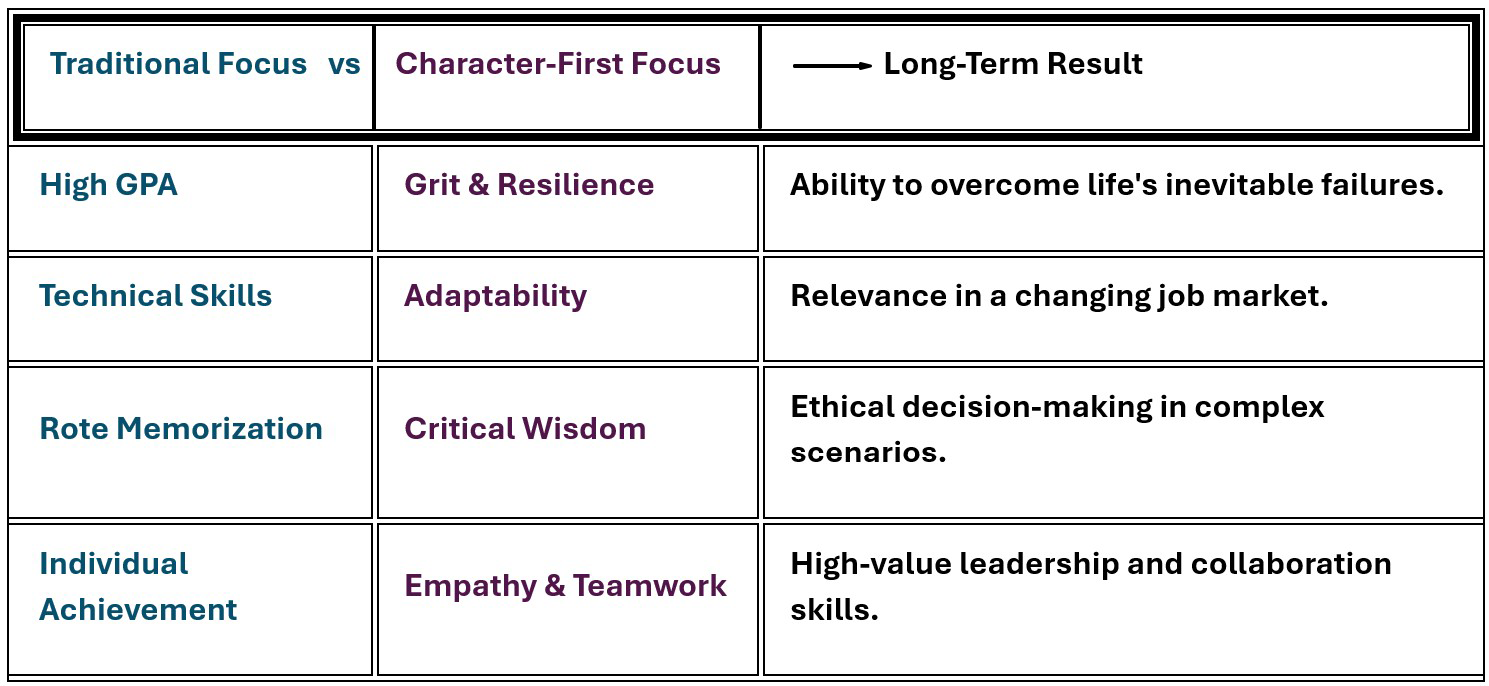
Here are 5 reasons why prioritizing character development creates a superior education for the long-term future.
- Future-Proofing Against Automation
We are entering an economic phase where technical skills become obsolete rapidly, and artificial intelligence can perform rote cognitive tasks faster than humans. However, AI cannot replicate high-level character traits.
-
- The Argument: Technical proficiency gets you the interview; character gets you the promotion. Skills like empathy, ethical judgment, and creative adaptability are the “human advantage.”
- The Outcome: A student focusing on character is building a skill set that machines cannot replace, ensuring their economic relevance regardless of how technology evolves.
- Resilience in a “VUCA” World
The modern world is often described as VUCA (Volatile, Uncertain, Complex, and Ambiguous). High grades do not necessarily prepare a student for chaos; character does.
-
- The Argument: Academic rigor without character development creates fragile students who crumble under failure. By prioritizing traits like grit and perseverance, you teach students that failure is data, not a definition. This is a true growth mindset!
- The Outcome: When these students face inevitable professional or personal setbacks in their 30s and 40s, they will have the internal infrastructure to bounce back and reinvent themselves.
- The “Attention Economy” Competitive Advantage
We live in an attention economy designed to fracture focus and erode patience. Possessing the character trait of self-regulation (discipline) is becoming a superpower.
-
- The Argument: The ability to engage in “Deep Work”—to sit with a difficult problem for a long time without distraction—is becoming rare. This is a character issue, not just an academic one.
- The Outcome: Students who cultivate self-control and delayed gratification will outperform peers who are intellectually capable but chronically distracted. They will be the ones capable of long-term strategic thinking.
- Ethical Leadership and Decision Making
Intelligence without ethics can be dangerous. As our tools (biotech, AI, data algorithms) become more powerful, the consequences of our decisions become weightier.
-
- The Argument: Standard education teaches students how to do things; character education teaches them what should be done. In the future, complex problems will not have clear “textbook” answers; they will require wisdom and moral courage.
- The Outcome: Your graduates will be trusted leaders. In a business environment plagued by scandals and short-termism, integrity is a high-value currency that attracts investors, partners, and loyalty.
- High EQ Translates to High Collaboration
Most modern innovation is interdisciplinary and collaborative. The “lone genius” archetype is largely a myth of the past; the future belongs to teams.
-
- The Argument: Character development focuses heavily on relational skills: humility, active listening, and kindness. These are the foundations of Emotional Intelligence (EQ).
- The Outcome: A student with high character navigates office politics, builds stronger networks, and resolves conflict efficiently. They amplify the intelligence of the people around them, making them indispensable to any organization.
…in a nutshell
You must be logged in to post a comment.